



The Colosseum and the Pantheon to open at night in August
- August 3, 2026
- Colosseum area, Pantheon area, What's On in Rome

 by C. P.
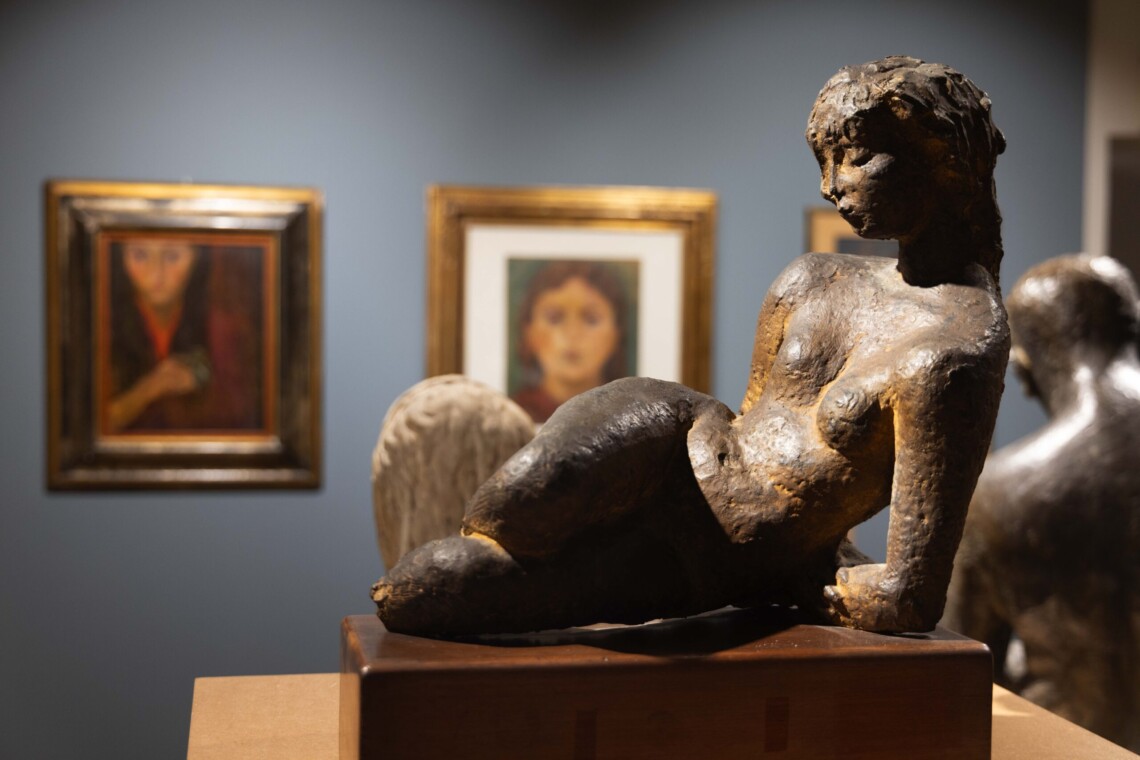

While the majority of visitors to Rome spend their days marveling at the Colosseum and the Vatican’s treasures, a quieter artistic story unfolds in the elegant Villa Torlonia museum complex. The exhibition “Un’altra forma di amore” (“Another Form of Love“) which will be on display until next November, celebrates the passionate partnership between Mario Mafai and Antonietta Raphael. These two artists’ love affair became the driving force behind one of Italy’s most fascinating yet overlooked art movements, the Scuola Romana.
Their story reads like a novel. Mafai, born in Rome in 1902, was a painter searching for his voice when he met Antonietta Raphael, a Lithuanian-Jewish artist who had fled to Paris and then Rome in the 1920s due to the persecutions against the Jewish communities in her home country. Their meeting sparked not only a lifelong romance but also an artistic revolution that would challenge the rigid cultural expectations of Mussolini’s Italy.
The Scuola Romana, which flourished from the 1920s through the 1940s, represented something rare in art history: a movement that was simultaneously deeply rooted in place and thoroughly modern. Unlike the grand gestures of Futurism, these Roman artists worked on intimate scenes—modest apartments, neighborhood streets, simple still lifes—with an intensity that transformed the ordinary into something profound.
Think of it as Italy’s answer to the Ashcan School that emerged in New York around the same time. Just as American artists like John Sloan and George Bellows found beauty and meaning in the everyday life of their rapidly changing city, the Scuola Romana artists turned their attention to the hidden corners of Rome. Quietly subversive, they painted the city not as the eternal monument that tourists see today, but as a living, breathing place where real people struggled, loved, and dreamed.
The movement’s aesthetic was distinctly anti-heroic. While Mussolini’s regime promoted bombastic art celebrating empire and power, Mafai and his circle painted cramped interiors, worried faces, and the melancholy light filtering through apartment windows. Their palette was often muted—dusty roses, soft grays, weathered ochres—colors that spoke of worn marble and afternoon shadows rather than imperial glory.
Beyond Mafai and Raphael, the Scuola Romana attracted an extraordinary group of talented artists, including Fausto Pirandello (son of the famed playwright Luigi Pirandello), Giuseppe Capogrossi, and Emanuele Cavalli. Scipione (AKA Luigi Bonichi) painted feverish, expressionistic scenes that captured the psychological tension of life under fascism. His canvases vibrated with nervous energy and distorted faces, expressing anxiety and desire. Roberto Melli brought a lyrical quality to his work, finding poetry in mundane subjects. Before his exile to America, Corrado Cagli created works that bridged classical Roman tradition with thoroughly modern sensibilities.
These artists were not united by a shared technique, but rather by a common feeling—a sense that art should capture the emotional truth of their particular moment in history. They painted not what Rome looked like in propaganda posters but what it felt like to live there as an artist, a woman, a Jew, or simply someone who saw the world differently from how the regime demanded.

The new exhibition’s location at the Villa Torlonia complex adds another layer to the story. Once the residence of the Torlonia banking family in Rome and later Mussolini’s home, the park now houses several museums celebrating the very artistic vision the fascist regime tried to suppress. It also has an archive devoted to the Scuola Romana!
The current exhibition “Un’altra forma di amore” uses the couple’s personal story as a lens through which to examine the broader Scuola Romana movement. Letters, photographs, and personal objects reveal how Mafai and Raphael’s artistic partnership sustained them through decades of political upheaval, war, and personal struggle. Their love story becomes inseparable from their artistic evolution: Raphael even gave up painting to distance herself somewhat from her lover and then husband. A tale of conflict as well as passion, the couple is inextricable from the history of modern Rome and has inspired later generations of artists.
Villa Torlonia is just the beginning of your Scuola Romana journey. Rome’s commitment to preserving this artistic legacy extends to several other venues that the majority of tourists never discover. The Palazzo Merulana, located on the charming Via Merulana, houses an impressive collection of 20th-century Italian art, including significant works by Scuola Romana artists.
Equally rewarding is the city-owned Galleria di Arte Moderna on Via Francesco Crispi, near the Spanish Steps but worlds away from the crowds. This often-overlooked gem contains one of Rome’s finest collections of modern Italian art, with dedicated spaces for Scuola Romana works.




Join The Discussion