



Rome with reduced mobility: an honest guide
- September 3, 2026
- Museums, Piazza Venezia area, Spagna area, Trevi area

 by C. P.

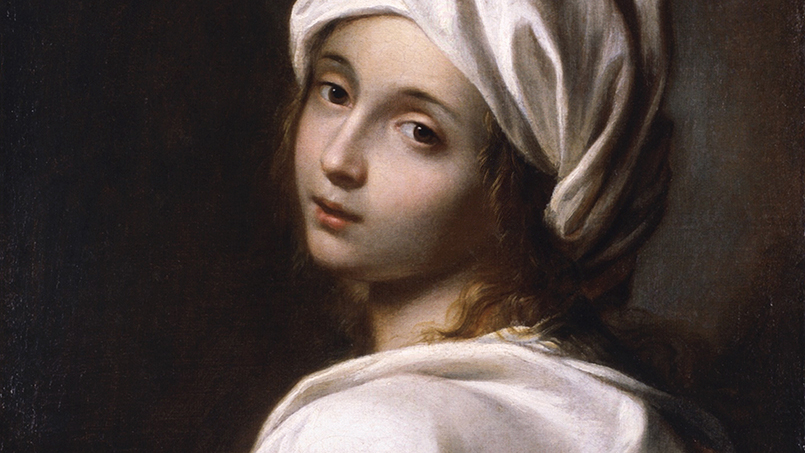
9/11 is a date forever etched in global memory because of the tragic events in New York, but it has an even deeper meaning for Romans: it’s the day Beatrice Cenci was executed in 1599. A killing so unfair that over the centuries Beatrice became a heroine and a symbol, celebrated by the likes of Caravaggio, Guido Reni (above you can see what is believed to be the portrait he made of the girl) and Shelley. This free walking tour is a homage to her memory.
This young woman (she was only 22 when she died) was born into the noble Cenci family, counts whose lineage allegedly dated back to imperial Rome.
His father, Francesco, was violent and raped Beatrice regularly, going so far as to imprison her in a secluded castle called La Rocca di Petrella Salto, in the region of Abruzzo. There, Beatrice, her brother Giacomo, their stepmother Lucrezia Petroni and her son from the marriage with Francesco, Bernardo, plotted for Francesco’s assassination: in spite of frequent complaints, reports and even arrests, Francesco had kept walking out of jail and resumed his vicious behavior.
Francesco was stabbed, but his death was made to look like he had fell to his death from a window, ending impaled on some branches.
In what is now considered one of the first “CSI” cases in history, an inquiry launched by both the Vatican (because the family was from Rome) and the Kingdom of the Two Sicilies (as the castle was on their territories) proved that the Cencis had planned the murder, even though they didn’t materially kill Francesco (two “hitmen” had been hired).
A year after the fact, the whole family with the exception of Bernardo (who was only 12 at the time) was executed and their properties conveniently went to Pope Clement VIII (the trial was considered a proper scam). To this day, Beatrice remains an icon for battered women.
Lungotevere Cenci, Piazza Cenci, Via Beatrice Cenci… even street names summon this tragedy, as if wanting to make amends for a glaring mistake. We’re right on the edge of the Jewish Ghetto, on the north-western side of the neighborhood. We’re walking distance from a number of From Home to Rome’s managed properties, particularly Catalana al Ghetto.
Palazzo Cenci, as it is still known to this day, is really on via Monte de’ Cenci, but those who are looking for Beatrice will better walk around it and reach Via Beatrice Cenci, on the back, where a great arch is below what was supposed to be the window for Beatrice’s rooms.
This area looked wildly different in the 16th century, and the palazzo itself is comprised of several buildings, erected for the most part on what used to be the Circus Flaminius, a racetrack not unlike the Circus Maximus, which used to stand on a side of nearby Theatre of Marcellus. While the mansion itself cannot be visited (it’s a private residence) you can marvel at the different architectural styles used in the area and you can have fun looking for clues to their previous inhabitants, perhaps imagining Beatrice itself walking around here.
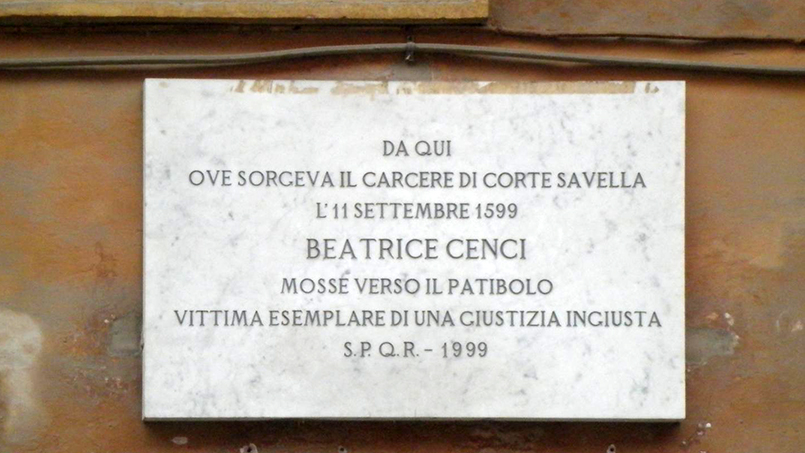
Corte Savella (“the Savella Courthouse”) used to be a courthouse-cum-jail standing on Via di Monserrato, 42, a few minutes from both Campo de’ Fiori and Piazza Farnese.
It bore the name of the Savelli family, who used the have a monopoly on Rome’s penal system. “Used to”, because Pope Innocent X, half a century after Beatrice and his family’s deaths, ruled for its suppression because of the inhuman conditions of the inmates there. So loud were their screams that the Pope was routinely reached by the grievances of the monks of the nearby Venerable English College who couldn’t pray.
The Corte Savella was the place where Beatrice and her stepmother were kept, tried and tortured before their execution (Beatrice’s brothers were imprisoned in Castel Sant’Angelo).
Today the building has been partly torn down and incorporated into the English College, but a plaque remembers this young woman, “exemplary victim of unjust justice”.
On September 11, 1599, Beatrice and the rest of her family were taken on the square outside Castel Sant’Angelo and executed in the open there. Troves of people were in attendance, many of them later dying because of the heat or rioting, the sign of a strong popular dissent against the decision made – basically – by Pope Clement VIII: scuffles started throughout the morning, trying to delay the execution. To no avail, alas.
Caravaggio was among the people who witnessed the whole ordeal, and so perturbed was he that it is said that his painting of Judith beheading Holofernes was directly inspired to the beheading of Beatrice.
The very sword used on Beatrice’s head was found in the river Tiber during the building of the Palace of Justice, north from this location, in 1800. According to legend, the executioner was so overwhelmed by guilt that he threw it away, later killing himself.
For those of you who love ghost stories: on the night of September 11, the ghost of Beatrice is said to be strolling up and down the square by Castel Sant’Angelo, cradling her head into her arms.
Placed at the base of the Janiculum Hill, this church is a must-visit for all of those wandering through the more uphill part of Trastevere, no matter their interest in Beatrice Cenci!
The final wish of the young noblewoman was granted when she asked to be buried here, by the altar, with an unmarked tombstone, as was common practice for those who had been sentenced to death.
It would be right here that we would go to lay a flower for Beatrice, were it not for the fact that in 1789 the French army desecrated several churches in Rome and this one in particular.
French soldier Jean Maccuse opened the tomb to steal the silver platter where the head of Beatrice had been placed, and was seen playing with her skull as one would do with a ball. As luck would have it, he himself was later beheaded… the curse of the Cencis, perhaps?




Join The Discussion