


The Colosseum and the Pantheon to open at night in August
- August 3, 2026
- Colosseum area, Pantheon area, What's On in Rome

 by C. P.

Whether it’s in artworks at the Vatican Museums or sculpted into famous obelisks, there is no doubt that depictions of elephants immediately grab the attention of tourists passing through Rome: such an exotic animal is immediately noticeable, but not everyone knows that they are not a metaphor (at least, not always!) but the representation of a precise phenomenon.
In fact, the presence of these animals in the city is well documented and there are traces of them in several locations! This post, then, is meant to give you a primer on a truly curious piece of history that is deeply connected to the evolution of the Eternal City.
It is widely known that a number of elephants were brought to Rome after the war campaign against Pyrrhus, however, these were certainly not the very first to find a home in the city.
Going back in time, when the Seven Hills were far from being populated, elephants were common throughout Roman territory. So much so, there is even a museum ” photographing” them there where they left their most important traces: in Casal de’ Pazzi (between the Talenti and Rebibbia districts, north/northeast of the center), open for free and only on weekends (booking is mandatory). In Museo Casal de’ Pazzi (at Via Egidio Galbani, 6) one can observe an ancient dried-up stretch of river and remains also left by other animals… including humans.
Some might believe these were mammoths, but the mild temperature, even at the time, of the area did not allow for their distribution. Instead, these were larger elephants compared to present-day standards, and traces of them were also found in much more central areas.
For example, bones emerged during the excavations to build Via dei Fori Imperiali. And again, building the Victor Emmanuel monument on Piazza Venezia: legend has it that the tusks of an elephant were embedded in one of the outer walls of the majestic monument, prompting a real treasure hunt to find them.
There is evidence of the presence of elephants in Rome throughout the history of the Empire and before it: of course we know that these were used to perform heavy labor, and also in the games that took place in the city’s different amphitheaters.
Elephant bones, for example, have been found both under the Colosseum’s arena and under that of the Castrense amphitheater, which floor is the only thing left, right next to the Basilica of Santa Croce in Gerusalemme (the arena today is bordered by a wall and on it is the vegetable garden run by the monks of the convent housed in the Basilica itself).
And we cannot fail to remember that according to the Historia Augusta, Julius Caesar earned his appellation (Caesar, indeed) for having killed an elephant (“Caesai”) in battle: our peninsula is dotted with findings of coins depicting him riding a pachyderm. A metaphor for his power, surely, but also a historically established fact.
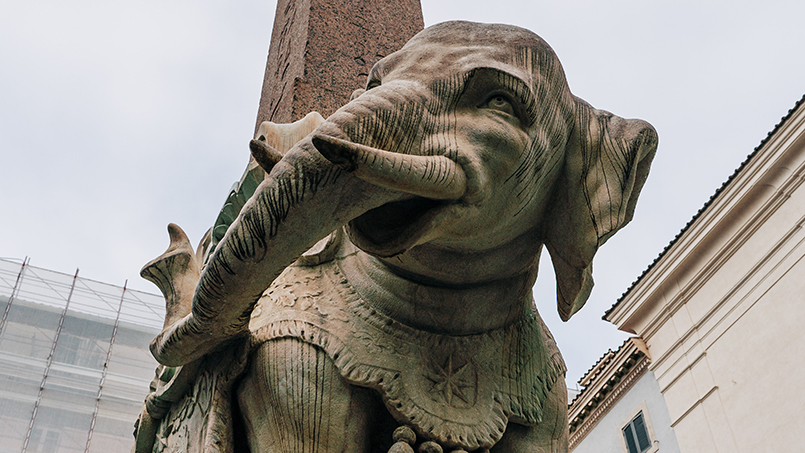
Images of elephants in art, however, date mostly from to the Renaissance and the times following it. You will be surprised to find that in the vast majority of cases the one portrayed is still the same animal!
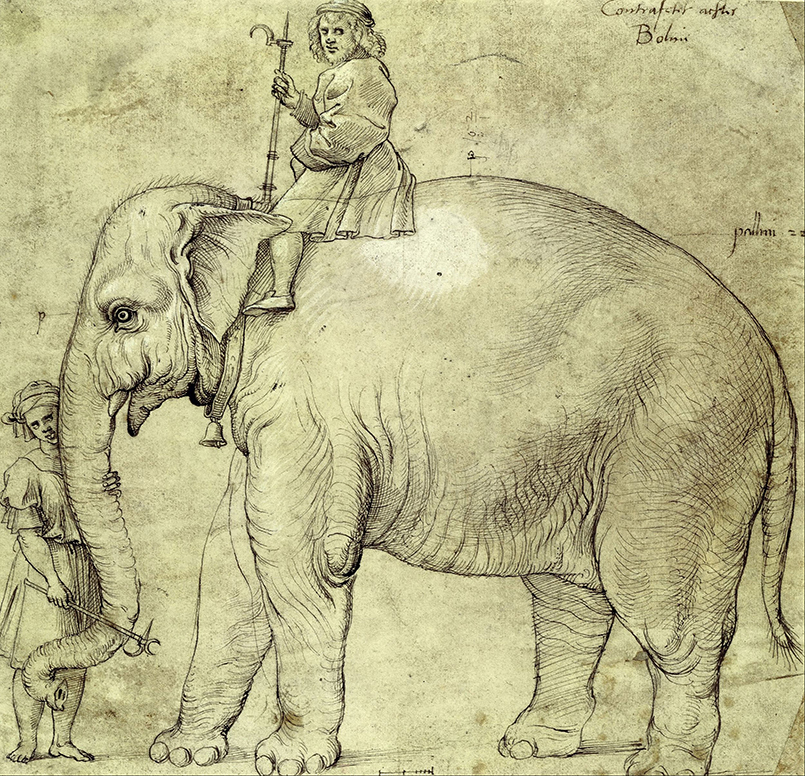
Its name was Hanno, and its bones were found in 1962 in the laying of some telephone cables in the Vatican. That’s because that pachyderm was the private property – or you could call it just the pet! – of Leo X, given to the pontiff in 1513 during a visit to Rome by the King of Portugal at the time, Manuel I. The pope was so fond of his elephant, he had it buried close to him and, aware that this was an extraordinary gift, he used to parade him through the streets of the center where it intrigued and fascinated the citizens (what’s more, it was an albino!).
Famous artists such as Raphael, Giulio Romano or Gian Lorenzo Bernini portrayed Hanno or played with his likeness to create their own works, some of which we can appreciate today Rome’s most famous streets and palazzi. The sightings of Capitoline elephants continue…. Where have you seen them?
If you’re traveling with children, you can use this anecdote to go look for elephants, painted or sculpted, among the city landmarks.




Join The Discussion