



The Colosseum and the Pantheon to open at night in August
- August 3, 2026
- Colosseum area, Pantheon area, What's On in Rome

 by C. P.

The Pieta by Michelangelo, the Saint Theresa by Bernini, the Marcus Aurelius, the She-Wolf… Rome’s art masterpieces include many a statue, but for the most part visitors coming to the city ignore that sculptors have kept producing must-see works way after the end of the Baroque era or the collapse of the Roman Empire.
This post aims at introducing you to some of the most famous of these modern works, and we have chosen a few that can give you food for thought and offer a wider understanding about the contradictions of the Eternal City.
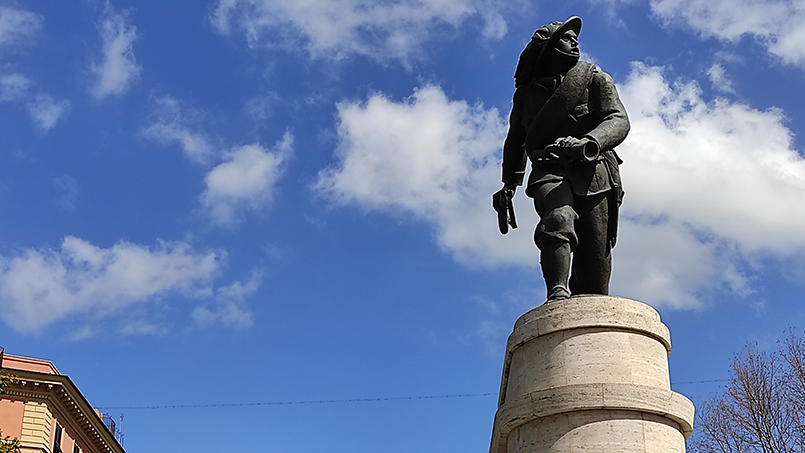
Bersaglieri are infantry soldiers and are recognizable by the black feathers on their hats (not to be confused with those on the Alpini corps!). They were famously the ones to breach the walls of Rome in 1870, an action that kickstarted the end of the Papal States as they were known until that point, and ultimately resulted in the unification of Italy. Not two minutes from the breach itself, artist Publio Morbiducci completed this massive bronze statue that was completed in 1932. Ironically enough, this Bersagliere stands opposite the Porta Pia gate, in an apparent message to the Church – not unlike the statue of Giuseppe Garibaldi on top of the Janiculum Hill, another jab at the Pope and another statue we suggest you visit while in Rome!
Where to see it: Piazzale di Porta Pia (north of Termini, you can reach it by bus (no. 90 from Termini, no. 60 from Piazza Venezia)
Religion (still) dominates the conversation, when it comes to art. Case in point: this bronze statue depicting Karol Wojtyla sparked different debates in 2011, when it was completed. First, its positioning was deemed inappropriate (as was the naming of the station to the recently deceased pope as he was, essentially, a foreign head of state). What’s more, the head in the original statue was so much smaller than the rest of the body that artist Oliviero Rainaldi was forced to take it out and redo it.
Where to see it: Piazza dei Cinquecento (outside of the Termini train station)
Speaking of debate, this modern-age obelisk created by Arnaldo Pomodoro should welcome every traveler entering from the south of the city, placed as it is in the EUR district, but many an unaware visitor has always wondered why a metal Christmas tree is there! We can’t blame them because as a matter of fact, this sculpture does remind of one. The intention was of course to replace the Egyptian obelisks looted during the Roman empire, as well as representing a “conversation” with other major landmarks in the area, such as the Palazzo dello Sport arena built for thr 1960 Olympics. Another major Arnaldo Pomodoro work everyone is familiar with is “Sphere within Sphere”, in the Vatican Museums’ Cortile della Pigna.
Where to see it: Piazzale Pier Luigi Nervi (EUR district, you can reach it by subway line B – nearest stop is EUR Palasport)
And because we just mentioned the 1960 Olympics, we would be remiss if we didn’t mention the adventurous story of the eight statues originally created by Amleto Cataldi for the Stadio Nazionale, the original stadium in Rome that was torn apart to build the Stadio Flaminio in its place. Dating back to 1927, these four couples were originally positioned on the higher ring of the stadium, and were stored away when the building was destroyed.
When Rome won the bid for the Olympics, somebody remembered that they existed, went to great lenghts to discover their location and finally had them placed in the Olympic Village, the Villaggio Olimpico area of the Flaminio district where they can be seen to this day. One pair of athletes is on Largo Indira Gandhi, one on Via Gran Bretagna and two are located in different spots of Viale della XVII Olimpiade.
Where to see it: in the Villaggio Olimpico area (Flaminio district, you can reach it by tram line no. 2 from Piazzale Flaminio)
Another early 20th century statue dominates the square opposite the Basilica of Saint John Lateran. It’s a bit of an oddity, really, since the most logical decision should have been a statue of Saint John rather than Saint Francis – but at the time, the area was deemed empty enough and worthy of a monument, so famed sculptor Giuseppe Tonnini was involved – he of the Altar of the Fatherland fame (along with his colleague Giuseppe Sacconi).
Where to see it: Piazza di San Giovanni in Laterano (you can reach it by subway line A, closest stop being San Giovanni)

For those who like modern art and wandering off the beaten path, the Villa Glori park (uphill from the Auditorium Parco della Musica and the Villaggio Olimpico area we just listed) is a must-see location. In the late 1980s a building inside the Villa was transformed into a hospice for terminally ill AIDS patients. This decision sparked, you guessed it, enormous debate, and art critic Daniela Fonti suggested that the Municipality of Rome established a permanent exhibition of contemporary art here, signifying the encounter between these modern-age pariahs and the rest of the city. The name of the exhibition is “Varcare la soglia” (“Crossing the Threshold”) and it can be visited to this day. It includes 11 works by as many sculptors, among them Paolo Canevari, Giuseppe Uncini, Jannis Kounellis, and many others.
Where to see it: there are two separate entrances to the park on Viale Maresciallo Pilsudski (Parioli area, walking distance from the Auditorium Parco della Musica, or reachable by bus with line 223 from Termini)




Join The Discussion