



Contemporary art lovers, visit Fondazione DARC!
- March 30, 2026
- Museums, Off the beaten path

If you’re the…
 by C. P.

When planning your trip to Rome, you’ve had it hammered into your brain from multiple blogs, books and YouTube videos that it’s enough to cross the river Tiber to enter a magical land where life is more authentic, people all know each other and food is better than anywhere else in the Eternal City.
These notions are repeated so often that the Trastevere district, ironically, has attracted visitors in droves and has become tourist central – exactly like other famous areas of Rome.
Sure, the architecture is akin to that of a Medieval village, some of the city’s best restaurants can be found in the neighborhood but… on an average night, pre-pandemic, you would have been hard-pressed to find any locals around. Such was the number of people from abroad!
To be fair, there is an area of Rome which matches the descriptions made by so many influencers, travel writers and… University brochures. And it’s still in Trastevere!
Curiously enough, it is in a part of the district just a handful of foreigners bother visiting. Is it because no public transport goes through it? Because there are almost no shops or restaurants? It is a mystery to us, because it’s incredibly poetic, still relatively untouched by mass tourism and drenched in history. That’s where we’re taking you with this walking tour post!
Foreign visitors in Trastevere know exactly where Porta Settimiana is, on account on it being so close to the well-known John Cabot University and to the supposed house of the Fornarina, Raphael’s muse and lover.
But if you’re one of those who do not know of it, locating it is easy enough: on any map of Rome, find Villa Farnesina or the downhill end of Via Garibaldi, and lo and behold Porta Settimiana is right by both of those!
It’s not like you can miss it, anyway: the top of the gate is complete withv-shaped merlons and looks like the entrance of a castle. Very medieval!
In spite of this addition, this landmark is actually much older, and the jury’s still out on whether it was first built when the Aurelian walls were erected in the 3rd century CE or it was already there as part of an aqueduct and then transformed into an actual gate.
As to its name the “settimiana” bit should be a nod to its original location: a contraction of septentrio (to the north of) Ianus (the temple of Ianus). While other hypotheses exists as to why the gate is called that, this one (and all of them, really) tell us how crowded with buildings this area was, even in Roman times. Mansions, temples, at least one aqueduct and several workshops – their remains are scattered through the area.
This walk is simple enough: past the gate, walk along the street ahead of you (“Via della Lungara“) to the north (the Vatican area begins exactly where the street ends), turning left and right for interesting things to see.
Walking past the gate to the north, you’ll have the river on your right side, uphill from you, and the John Cabot University on your left. Also on your left is Largo Cristina di Svezia, named after Christina, Queen of Sweden, who died here after being deposed.
At the end of this small square are Rome’s botanical gardens, maintained by the city’s largest and oldest university, La Sapienza.
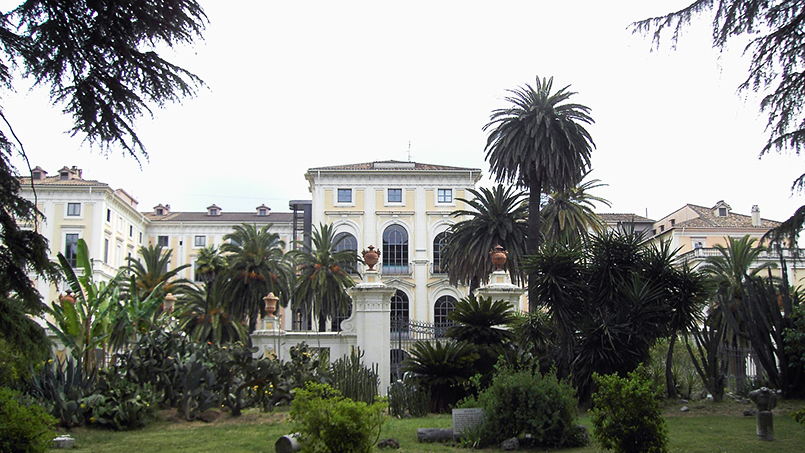
The botanical gardens were originally a portion of the Palazzo Corsini property – the palazzo itself is further ahead on via della Lungara. Being on one slope of the Janiculum hill, the botanical gardens develop uphill and offer sweeping views of the rest of the city. A recommended visit, even if you don’t like… well, plants!
Back to Palazzo Corsini: this is one of the two branches of the National Gallery of Ancient Art, which main building is in Palazzo Barberini: the Trastevere wing has works by Caravaggio, Artemisia Gentileschi, Van Dyck or Rubens, among others.
Opposite its entrance you have Villa Farnesina, with frescoes by Raphael – another must-see in the area.
Don’t overlook the streets on your left – they all hide something peculiar! One example is contemporary art galleries: you’ve got some of Rome’s most interesting and original examples on Via delle Mantellate (“Studio Stefania Miscetti”), Via di San Francesco di Sales (“Fondazione Volume!”) or Vicolo di Sant’ Onofrio (“Ex Elettrofonica”).
Art galleries aside, these alleys are the home to cooking schools, another small museum (“Casa della Memoria e della Storia”), bookshops, the occasional, tucked-away bar or restaurant and… nunneries!
Churches and convents at every corner are nothing new in Rome, but in this area there’s such an overabundance of them that one was even turned into what is now the oldest, still operating prison in Rome, Regina Coeli (“Queen of Heaven”), which name betrays its previous nature.
Regina Coeli is on your left past the Palazzo Corsini museum, but if you don’t know about its designated use you would walk past it without giving the building any thought: it looks like an ordinary – if ancient – office building.
The reason behind such a massive religious presence is that Via della Lungara itself was once known as Via Sancta, the Holy Road, leading pilgrims coming from the south of Italy towards St. Peter’s – some found shelter and a new life around these parts.
Another former convent follows along the road: since 1987, the Convento del Buon Pastore (“Good Shepherd”) has been the home for groundbreaking feminist association Casa Internazionale delle Donne.
This particular convent (doubling up as a women prison) had been built originally for former prostitutes or women abused by their husbands, way back in 1615. The complex now houses essential services for women in need, but it also focuses on financing itself through concerts, art exhibitions, movie screenings or book festivals. They have a cafe-cum-bistro in their courtyard, which we suggest you check out!
Compared to other areas of Trastevere, and in spite of its proximity to, yes, a prison and the very busy Lungotevere boulevard, you will be surprised at how quiet this area is.
Not that it was always like this: since 1725, Via della Lungara’s most famous (or, infamous) building with the exception of the Regina Coeli prison had been Rome’s asylum.
It was originally built thinking the Trastevere area was so “far” from the city center not to bother Rome’s citizens, but as the city started to expand a decision was made to move it in the Monte Mario district, north of the Vatican. The old asylum was eventually torn apart to make space for the lungoteveri and the river embankments below those. Many young Romans today don’t even know it was there to begin with.
As you walk towards the Vatican area, taking a detour on Via degli Orti di Alibert will give you a glimpse of the majestic Villa D’Alibert, hidden behind a stone wall. This 17th century palazzo belonged to the secretary of Queen Christina of Sweden. If you look hard enough you might be able to see a majestic fountain right in the façade of the building, looking like scattered rocks.
A small door at the base of that led to the water main, but when the fountain was no longer in use that same conduit became a tunnel which lead to the Janiculum Hill above. This proved particularly useful when the Nazis started raiding regularly Rome between 1943 and 1944. Romans who were arrested were taken to nearby Palazzo Salviati, the last major building as Via della Lungara turns into Piazza della Rovere and the end of our walk.
Once the Military Academy of Rome, currently the Italian Defense Higher Studies Institute, it was used as a stopover before shipping prisoners to the concentration camps. Some of them were able to escape through the nearby D’Alibert property, but of the 1.023 Jewish romans caught by the Germans, only 16 did return from Auschwitz.
If discovering local history and being away from big crowds are among your priorities as you begin traveling again, do get in touch with us! Some of our best reviewed accommodations are right in this part of Trastevere, and they include Via della Mantellate and Domus Claudiae.

If you’re the…


Join The Discussion